

Rolex Daytona vs Audemars Piguet Royal Oak: The Ultimate Comparison
Two of the most coveted watches on the secondary market. The Daytona and the Royal Oak both command significant premiums, but they are very different watches for very different buyers.
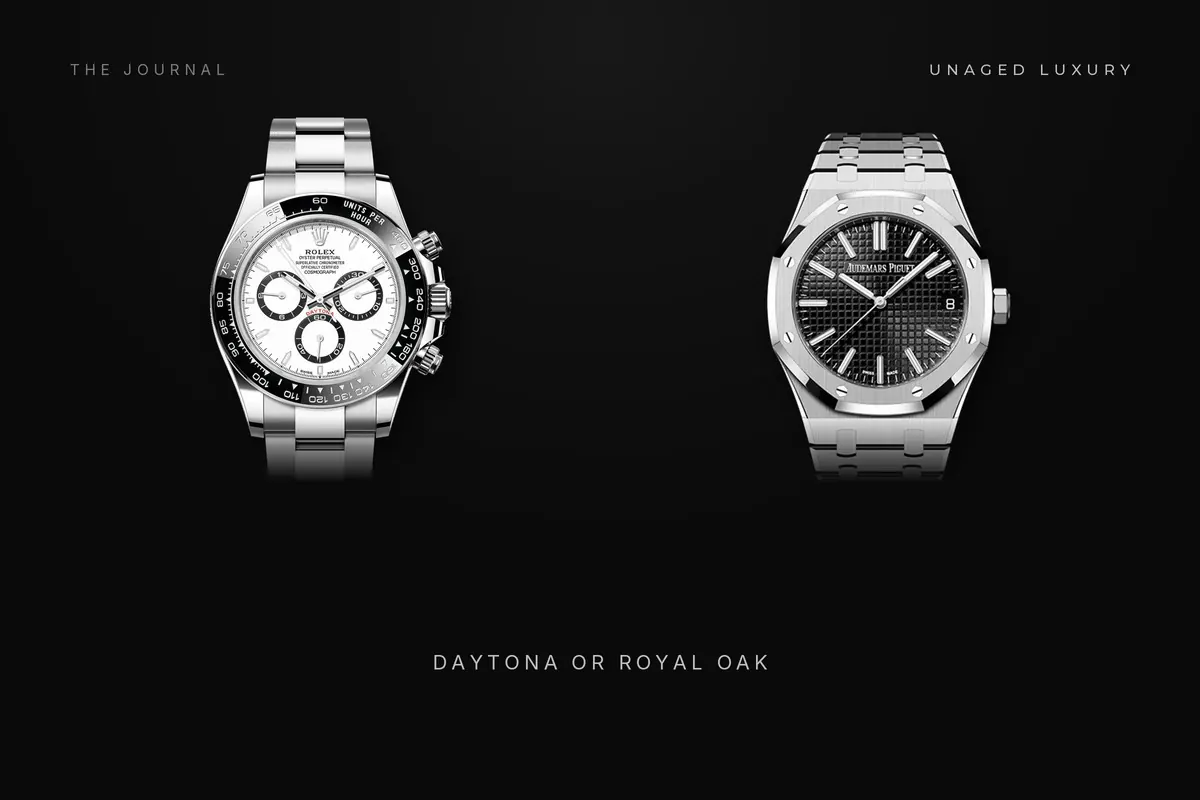
Two Icons, One Decision
The Rolex Daytona and the Audemars Piguet Royal Oak are two of the most recognized watches in the world. Both trade at significant premiums on the secondary market. Both have waiting lists at authorized dealers that stretch years. And both attract buyers who want a watch that is immediately recognizable as something exceptional.
But they are not interchangeable. The Daytona and the Royal Oak represent different design traditions, different movement philosophies, and different statements about what you value in a watch.
The Rolex Daytona
The Daytona was introduced in 1963 as a racing chronograph, named after the Daytona International Speedway. For most of its early history it was a slow seller, the manual-wind movement and the racing association did not resonate broadly. That changed in the 1980s and 1990s as the watch became associated with Paul Newman, and the secondary market has never looked back.
The modern Daytona (ref. 116500LN, now 126500LN) uses Rolex's in-house caliber 4130, a column-wheel chronograph movement with a vertical clutch. It is one of the most reliable chronograph movements in production. The ceramic bezel, introduced in 2016, addressed the only real criticism of the previous generation.
For a full breakdown of what to look for when buying a pre-owned Daytona, see our Rolex Daytona buyers guide.
The Audemars Piguet Royal Oak
The Royal Oak was designed by Gerald Genta in 1972 as a luxury sports watch in stainless steel, a concept that was genuinely radical at the time. The integrated bracelet, the octagonal bezel with exposed screws, and the tapisserie dial created a visual language that has never been replicated successfully by anyone else.
The Royal Oak 15202 (Jumbo, 39mm) and 15500 (41mm) are the references that define the collection today. The movement in the Jumbo, caliber 2121, is one of the thinnest automatic movements ever made, and it has been in production since 1967. The Royal Oak Offshore, covered in our Royal Oak Offshore buyers guide, takes the design in a more aggressive direction.
For the history and value trajectory of the Royal Oak, see our Audemars Piguet Royal Oak history and value guide.
Secondary Market Performance
Both watches trade at premiums above retail, but the dynamics differ.
The Daytona's secondary market is deep and global. It is one of the most liquid watches in the world, you can sell a Daytona in good condition quickly, almost anywhere. The premium above retail has moderated from the peaks of 2021 to 2022 but remains substantial for the current reference.
The Royal Oak's secondary market is similarly strong, but more sensitive to reference and configuration. The Jumbo 15202 in steel commands the highest premiums. Colored dials, blue, green, grey, trade at premiums over the standard blue tapisserie. The 41mm 15500 is more accessible but still trades above retail.
Design and Wearability
The Daytona is a 40mm chronograph with a relatively conventional round case. It wears well on a range of wrist sizes and is versatile enough for both casual and formal settings. The three-register dial is busy but purposeful.
The Royal Oak is more polarizing. The integrated bracelet and the octagonal case are distinctive in a way that not everyone finds comfortable, both aesthetically and physically. The Jumbo at 39mm wears smaller than its dimensions suggest due to the integrated bracelet. The 41mm is more contemporary in feel.
The Decision
Buy the Daytona if you want a chronograph with proven reliability, maximum liquidity on the secondary market, and a design that works in almost any context.
Buy the Royal Oak if you want a watch with a more distinctive design identity, a movement with genuine horological significance, and a place in the history of luxury watch design.
Both are available through UNAGEDLUXURY. Contact us to discuss current availability and pricing.
Further Reading
- Rolex Daytona Buyers Guide, What to look for when buying a pre-owned Daytona.
- Audemars Piguet Royal Oak History and Value, The full story of the Royal Oak and where it stands today.
- Pre-Owned Rolex as an Investment, How the Daytona fits into the broader Rolex secondary market.
Referenced in this guide
Value any watch- Rolex 1520215202Value it
- Rolex 1550015500, full set$73,000
- Rolex Cosmograph Daytona 116500LN116500LN, full set$35,000
- Rolex Cosmograph Daytona 126500LN126500LN, full set$41,000
Estimates. Not offers. Retail-equivalent, today.