

Luxury Watch Servicing: What to Expect and When to Do It
A watch that has not been serviced in a decade is a watch at risk. Here is what a proper service involves, how much it costs, and how it affects resale value.
Why Servicing Matters More Than Most Buyers Realize
A mechanical watch is a machine. Like any machine, it requires periodic maintenance to function correctly and to avoid damage from worn components. The lubricants that reduce friction between moving parts degrade over time. Gaskets that maintain water resistance harden and crack. Worn components that are not replaced can cause damage to other parts of the movement.
A watch that has not been serviced in a decade is not just running less accurately, it is a watch where the risk of internal damage is increasing with every passing year.
For buyers in the pre-owned market, service history is one of the most important factors in evaluating a watch, alongside condition grading and authentication. For owners, understanding when and how to service a watch is essential to protecting its value and longevity.
Service Intervals by Brand
Different manufacturers recommend different service intervals, and the right interval also depends on how the watch is used.
Rolex recommends service approximately every 10 years for modern references, though many watchmakers suggest 5-7 years for watches that are worn daily. Rolex's in-house movements are robust and well-sealed, which supports longer intervals.
Patek Philippe recommends service every 3-5 years. Patek's movements are more complex on average than Rolex's, and the brand's service standards are exacting. A Patek that has not been serviced in 10 years is a Patek that needs attention.
Audemars Piguet recommends service every 3-5 years. The Royal Oak's integrated bracelet and case design require specific expertise for disassembly and reassembly.
Richard Mille recommends service every 3-5 years. The brand's movements are technically complex and use materials, titanium, carbon, LITAL alloy, that require specialized knowledge to service correctly.
What a Full Service Involves
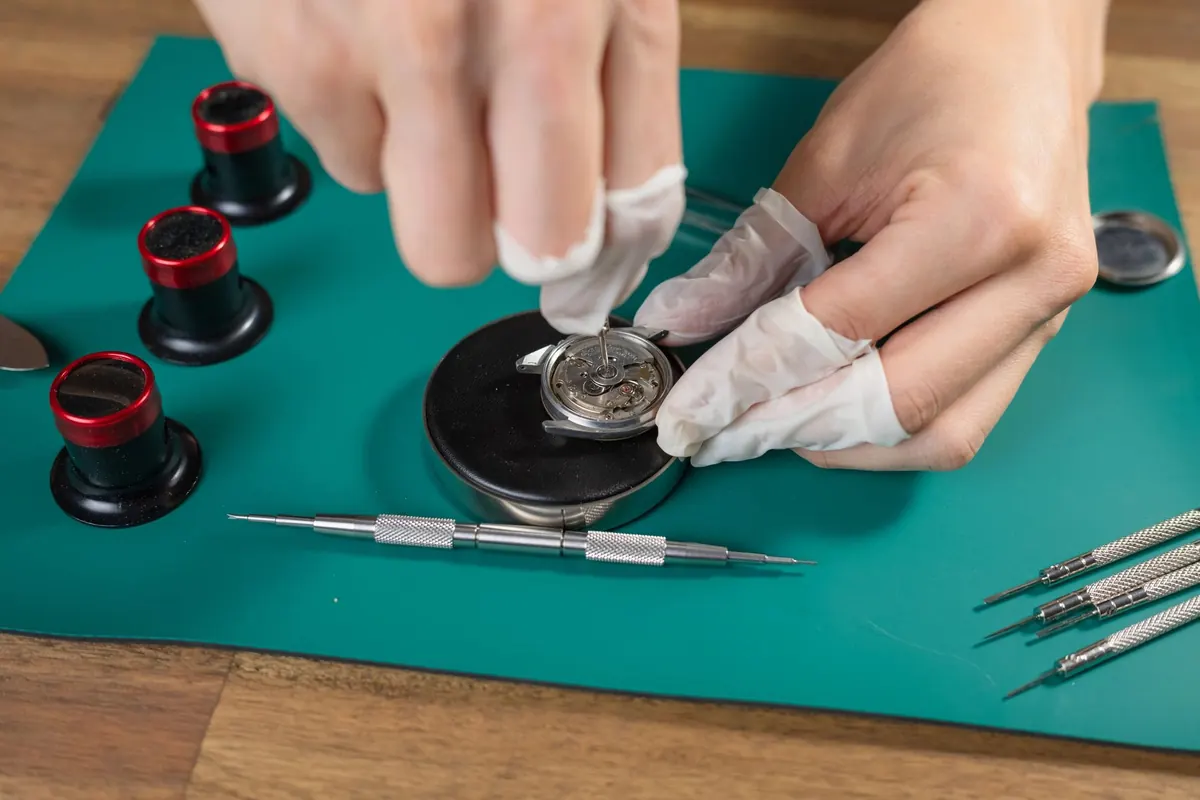
A full service is not a quick tune-up. For a mechanical watch, it involves complete disassembly of the movement, cleaning, inspection, replacement of worn components, re-lubrication, reassembly, regulation, and testing.
Disassembly. Every component of the movement is removed, catalogued, and inspected. Springs, jewels, wheels, bridges, and plates are examined for wear or damage.
Cleaning. Components are cleaned ultrasonically to remove old lubricants, dust, and debris.
Inspection and parts replacement. Worn components, mainsprings, gaskets, crown seals, are replaced. A reputable watchmaker will document what was replaced.
Re-lubrication. Fresh lubricants are applied to specific points in the movement. The type and quantity of lubricant matters, too much is as problematic as too little.
Reassembly and regulation. The movement is reassembled and regulated to run within the manufacturer's specified accuracy tolerances.
Timing and testing. The watch is tested on a timing machine and worn for several days to confirm accuracy. Water resistance is tested if the watch is rated for it.
Case and bracelet service. A full service typically includes cleaning the case and bracelet. This does not mean polishing, a reputable watchmaker will clean without altering the case finish unless the owner specifically requests polishing.
Service Costs
Service costs vary significantly by brand, reference, and complication.
Rolex. A full service for a modern Submariner or GMT through Rolex's official service center runs approximately $800-1,200. Independent watchmakers with Rolex experience typically charge $400-700 for the same work.
Patek Philippe. Patek's official service is more expensive, $1,500-3,000 for a straightforward three-hand watch, more for complications. The brand's service standards are extremely high, and the cost reflects that.
Audemars Piguet. Similar to Patek, $1,500-2,500 for a Royal Oak through official channels.
Richard Mille. Richard Mille service is among the most expensive in watchmaking, $3,000-8,000 depending on the reference and complication. The brand requires service through its own network.
How Service History Affects Resale Value
A watch with documented service history from a reputable watchmaker is worth more than an identical watch without it. The documentation demonstrates that the watch has been maintained, that worn components have been replaced, and that the movement is in good working order.
For vintage watches, service history is particularly important. A vintage Rolex or Patek that has been serviced by a qualified watchmaker, with original parts used where possible, is a more defensible purchase than one with unknown history.
One important note: service does not mean polishing. A watch that has been serviced but not polished retains its original case finish and its full collector value. A watch that has been polished during service has lost something that cannot be recovered. This is why understanding how polishing affects condition grades matters when evaluating any pre-owned piece.
Buying a Watch That Needs Service
When buying pre-owned, a watch that needs service is not necessarily a bad purchase, but the cost of service should be factored into the price. A Rolex Submariner that needs a full service is worth $600-800 less than an identical example that was recently serviced.
At UNAGEDLUXURY, we note service history in every listing and factor service needs into our pricing. If you have questions about the service status of a specific piece, we are happy to provide details.
Further Reading
- Luxury Watch Condition Grading Explained, Service history is one of the key condition factors. Here is how to read the full picture.
- How Watch Consignment Works, If you are selling a watch that needs service, here is how to think about whether to service it first.
- Rolex Submariner Buying Guide, Service history matters more on some references than others. Here is what to check on the Sub.